

In this session, we review a number of factors involved in effective pneumonia treatment and prevention programming.
Sorry, this activity is currently hidden
-
-
Students mustView
Show More-
In order to be able to complete the activities and quizzes in this course, and receive a certification of completion, you must create an account and enroll in the course. You only need to create an account once, after which you can enroll in as many courses as you like. Click here to create an account.
-
Pneumonia
This course is part of the Global Health eLearning Center (GHeL) Archive, originally developed by the U.S. Agency for International Development (USAID). It has been updated and adapted by NextGenU.org to ensure continued access to this valuable public domain training.
NextGenU.org is committed to preserving these resources as free, accessible, and globally relevant tools for professional development in public health. While we are not affiliated with USAID, we honor the mission of the original GHeL by keeping these materials accurate and actionable for today’s learners.
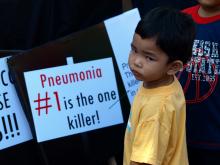
Pneumonia is a major killer of children under five years of age. Although children's mortality resulting from pneumonia has decreased in the last two decades, it is still the leading cause of death for children under five globally.In this course, you will learn what needs to be done for further reduction of this preventable disease.
Objective
By the end of this course, you will be able to do the following:
- Describe the epidemiology of pneumonia worldwide
- Describe principles of pneumonia case management in children under five years of age
- Discuss approaches that can reduce pneumonia-related mortality
- Explain why pneumonia interventions are one of the top priorities in child survival programs aimed at reducing under-five mortality in low- and middle-income countries
Credits
Special thanks to Marina Budeyeva, BASICS, who authored the first edition of this course (published August 9, 2008).
The course authors would also like to thank the following individuals for their contributions to the course revision: Troy Jacobs and Malia Boggs from USAID; and Kate Gilroy, Dyness Kasungami, Sarah Lackert, Michel Pacque, Zeenat Patel, and Serge Raharison from MCSP/JSI.
Time- 2 hours
Published/Updated
- Friday, April 14, 2017
Course Authors:
-
Rachel Bonawitz MD, BUSPH, Center for Global Health and Development
-
James Wolff MD, MPH, BUSPH, Center for Global Health and Development
Course Managers:
- Patricia Jodrey, USAID
-
This session explains how pneumonia develops and its contribution to global mortality rates. Pneumonia is the leading killer disease of children worldwide. Its burden is greatest in low- and middle- income countries in Africa and Asia.
-
Students mustMark as done
-
-
This session reviews the basics of classifying and diagnosing pneumonia, with emphasis on two approaches to case management: Integrated Management of Childhood Illness (IMCI) and Integrated Community Case Management (iCCM).
-
Students mustMark as done
-
-
This session covers the main principles of treatment for pneumonia in children, including appropriate antibiotic therapy and oxygen therapy.
-
Students mustMark as done
-
-
In this session, we cover different evidence-based methods to help prevent pneumonia in children.
-
Students mustMark as done
-
-
-
Students mustMark as done
-
-
-
Students mustReceive a gradeReceive a passing grade
Congratulations - you have nearly completed this course! The final exam will test your understanding of the material presented. If you score 80% or better on the exam, you will receive a printable certificate of completion.
The Learning Center will keep track of the courses that you successfully complete, which you can view in your Learner Home. If you do not score better than 80% on the final exam, we invite you to return to the course for further study, and then try the exam again. There is no limit to the number of times you can take the exam.
You should be able to complete the exam and final steps in less than 30 minutes.
-
-
-
Students mustMark as done
-
-
-
Students mustMark as done
-
-
 In this section, you can provide feedback about this course to help us make NextGenU.org better. Once evaluations are completed, you will be able to download your certificate of completion.
-
Students mustViewSubmit feedback
Your feedback is very valuable to us and can help us improve future courses. It should take you approximately 5 minutes to complete this evaluation.
Your responses will be kept confidential (i.e., individuals will not be identified), and may only be used for illustrative purposes in providing feedback for improvement on this or future eLearning courses.
-
-